Once again i must start a post by apologizing to the handful of people following this blog for the absurdly long time between posts. Once I returned to Palestine from Egypt I spent a few days trying to catch up on some rest and the last week or so rather ill. That said, I need to get my trip to Cairo recorded on here before it disappears into the deep corners of my mind. I suppose there is no better place to start then at the beginning.
Renewing a visa for Israel by crossing a land border is a pretty unpleasant experience, if not for the fear of the coming interrogation, then for the looming dread that you could always just get turned away at the border. If this happens, to have just become separated from the majority of your possessions which are at the apartment and without the savings to exactly hop on a plane back home. No matter how excited I am to journey in the Middle East on these little breaks every three months, this gloom presses on my spirit and traps me in anxiety for the duration of each trip across the border.
Flying to Cairo, in regards to being affordable, was simply not an option. A ticket from Ben-Gurion in Tel Aviv to Cairo is between 350-400 dollars, while a round trip bus tickets in retrospect cost a little under 100 dollars. In the end, I had to choose between my time/comfort and ease of travel. I chose the bus routes, but I would never, ever recommend this to an inexperienced traveler. I left Ramallah in the mid afternoon, to catch the evening bus out of Jerusalem. I had to lug my baggage up to the mass transit bus system and then stack it on my lap before heading for the Qalandia checkpoint between the West Bank and Israel. This takes about an hour or so depending on traffic both in the cities and at the border. Once I arrive in Jerusalem, the final bus stop is near the Damascus Gate in East Jerusalem to the Old City. From here, I could have taken a taxi to the central bus station, but this would have cost me a good chunk of change (due to how prohibitively expensive Israel is on a Palestinian Salary), so instead I walk, with my bags, to the central bus station which is about 2 miles away. I arrive, sweaty and stinky I'm sure and next have to pass through metal detectors and a bag inspection to buy my ticket and wait for my bus.
This bus trip I've made before (when I had previously gone to the Sinai for a visa renewal) and besides that it was dark out, so there really is not much to tell about this leg of the journey. I arrived in the border city of Eilat at around 11PM and had decided to try a different hostel then the one I had previously stayed in. I had made reservation at a place named the Shelter Hostel, which was tucked away on a suburban street but looked to be in pretty good condition. That said, I really should have gone with the place from my first trip to Eilat. They had no internet (what kind of hostel doesn't have internet!?) and they locked the gates at 12AM, which is bizarre because I am used to hostels and hotels being open for late checkout and checkin. I was too exhausted to care though and once I got my room and blankets, i happily headed off to sleep. The next morning, I needed to go to the Egyptian Consulate to arrange for my visa. Visa's to the Sinai can be granted at the border, but if you wanted to head to the interior you had to drop your passport off in the morning and collect it again in the afternoon, after completing the application process. I got a little lost in Eilat (I hate roundabouts) but eventually made my way to the Consulate, where I think my Arabic impressed them slightly and made the process easier. They told me to come back at two, so I headed back to the hostel to kill some time and do a little more research on Cairo.
Back at the hostel, I came to a sharp awakening, apparently this was some kind of super christian hostel, complete with a daily bible study held in the only central location where I was hoping to do some reading. I politely declined to join the bible study the first time, the second time they asked I was much more blunt. I found it pretty intrusive and offensive to push religion on a paying costumer and was happy when the time rolled around to get my passport from the consulate. Passport and luggage in hand, I headed to the Eilat bus station to catch the next trip to the border.
Of course the woman at the Israeli border is a sour, rude person asking questions repeatedly and with a snide tone of voice. I made a mental note that I will not stand to be treated this way when I come back through the border and begin to make plans to avoid such treatment and dehumanizing behavior. After the Israeli border the Egypt border has always felt so pleasant. They are much friendlier and helpful, and treat foreigners as guests and not possible terror suspects. A couple hundred meters down the road I load up on the bus to Cairo, which takes around 8 or 9 hours. I try to sleep some on the bus, but there are checkpoints every 30 minutes or so which require you to wake up and show your passport to the soldier who boards the bus. It's well past sunset by now and I can see nothing out the window but black fields and mountains, with the glow of the moon being the only way to differentiate forms in the darkness. There is another American on the bus, to be more specific he is actually another Washingtonian. He had formerly studied Arabic in Egypt and was now back in the region to try and get across the border into Libya to do some journalist work there. He was seemed like a nice guy, about the same age as me, and we talked sporadically between sleep and boredom.
The final checkpoint on the way to Cairo required us to gather our bags and get off the bus for them to be inspected. It is sometime around 10 or 11 at night by now and I have been travelling for over a day and a half from my home in Ramallah. The soldiers I must add, were very pleasant and respectful even when going through our things. One young soldier asked if I had a camera with me when he found out that I had come from Israel and asked me to show him my pictures (this is not uncommon here). I obliged by pulling out my camera and turning it on- only to reveal that I had completely deleted all pictures! There were also no pictures on my laptop, (which I had wiped clean of pretty much anything of importance). He asked me why I had no pictures to which I replied "because I knew people would want to see them" he smirked and told me to get back on the bus and enjoy my visit. I loaded back up and closed my eyes for the final hour into Cairo.

Wednesday, March 30, 2011

Tuesday, March 15, 2011


Saturday, March 12, 2011
Cairo
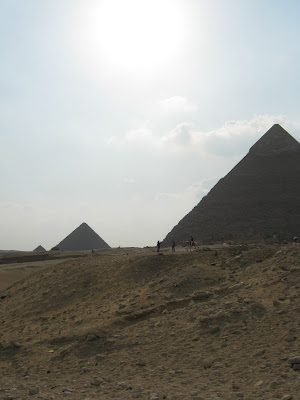
Well I just tried to to this few minutes ago, but the page crashed so here we go again. I'm going to pout pictures up now and fill in the stories later so that I may enjoy this wonderful vacation. Here's the first set: The Giza Plateau!



43 39' 19"N, 75 27' 42"W


43 39' 19"N, 75 27' 42"W
Wednesday, February 16, 2011
Walking the Old City Walls

This is just outside the Qalandia, the main checkpoint between the West Bank and Jerusalem (Al-Quds in Arabic). Most spots on the wall are just random script graffiti but this section has some really beautiful murals on it.


That's all for today! Sorry they are few and far between, but I hope some of you out there are still enjoying the blog
Subscribe to:
Posts (Atom)